Cumbria asks a lot of a garden. Rain comes in sideways off the fells, ground sits wet through winter, and frost can still catch exposed beds in May. Anything built here has to earn its keep. Local slate and stone do exactly that, and they do it while looking as though they have always been there — grey-green walling settling into a damp bank, flags that stand up to boots and wheelbarrows, chippings that keep alpine crowns dry in a wet county.
Why local stone earns its place
Cumbria's geology is unusually varied for a county its size, and that variety is useful. The Borrowdale volcanic rocks give the green slate quarried around Honister and much of the grey-green walling stone seen across the central Lakes. Westmorland slate splits into thin, hard flags. Limestone country around Kendal and Kirkby Lonsdale supplies paler, warmer tones, red sandstone appears near the coast, and Shap granite sits to the east.
What matters more than a quarry name is performance. Dense, low-porosity stone shrugs off the freeze-thaw cycle. Soft or flaky stone soaks up water, then spalls apart when that water freezes. If you are buying from a quarry or a reclamation yard, ask where the stone came from and whether it has been used outdoors locally. Someone there will usually tell you straight.
Colour matters too, though not in the way catalogues suggest. Look at the walls, bridges and field boundaries within a mile of your garden, and copy them. Local stone sits easily against the landscape; a load of imported pale paving can make everything around it look slightly wrong.
Choosing the right material for the job
Most gardens need three or four different grades, not one.
- Walling stone — roughly flat, roughly fist-sized, for dry-stone walls, raised bed faces and low retaining edges. Order a mix of sizes; the small pieces are the hearting that holds everything together, not waste.
- Flags and paving — 25–40mm thick for a path or patio, laid on a compacted sub-base of grit or crushed stone.
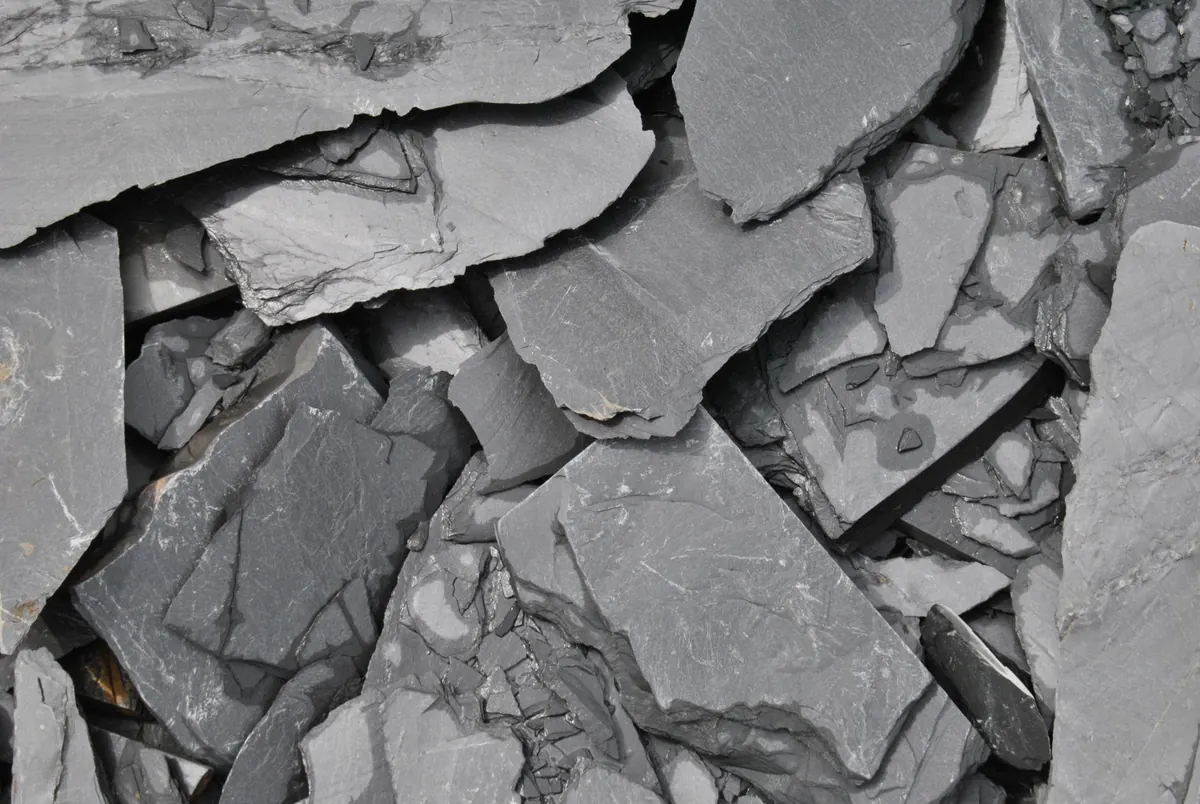
- Slate mulch — 20–40mm graded chippings for alpines, herbs and gravel-style borders.
- Gravel and chippings — 14–20mm for paths and open ground, laid over a membrane.
- Boulders and rockery stone — for a rock garden, a wet corner, or a single piece marking a change of level.
- Coping and step stones — a dry-stone wall only looks finished once the top is dealt with.
Order by the tonne rather than by the bag, and add about ten per cent for wastage and settling. Ask about access before you buy. A tipper lorry needs a solid, reasonably straight approach, and a tonne of stone on a pallet at the roadside is a very different job from a tonne in the back garden.
Slate mulch: the quiet workhorse
Slate chippings do more than tidy a border. Laid 40 to 50mm deep, they stop soil splashing onto leaves — which matters in a county where rain is a weekly event — and they hold a layer of dry air around the crowns of alpines and other plants that rot in wet winters. Dark slate warms quickly in spring; the paler green-grey grades reflect light and suit a shady corner.
It works best in rock gardens and raised beds planted with saxifrage, dianthus, sempervivum, thyme, lewisia and campanula, in herb and lavender plantings that want sharp drainage, and around the base of a wall where you want to hide the join between stone and soil.
Where it does not work: blanket a heavy clay bed in slate and you may slow water movement rather than help it. Break up the clay, add grit and organic matter, and keep the mulch to areas where drainage already functions. Woodland plants such as ferns and astilbes want leaf mould, not slate. Top up every few years with a thin layer rather than digging it in, and wear gloves — the edges are sharp.
Dry-stone walls, raised beds and rock features
Dry-stone work is the signature Cumbrian feature, and the reason it lasts is simple: it moves. Water drains straight through it, frost lifts it and drops it again, and it stays standing because the stones are locked together by weight and friction rather than by mortar.
Foundations
Dig a trench wider than the wall and fill it with compacted larger stones. A dry-stone wall wants a broad base and a face that leans back slightly — a gentle batter — so the wall's own weight pushes inward against the soil it holds.
Hearting and through stones
The middle of the wall is packed with small stones, wedged tight as you build. Skip this and the faces will bulge and drop within a couple of seasons. Every metre or so, lay a longer stone right across the wall to tie the two faces together. Behind a retaining wall, add clean rubble and a land drain, or water will find the stone and push.
Coping
Finish the top with coping stones, either flat and slightly overhanging or set on edge in the traditional vertical style. This sheds water away from the heart of the wall.
Most garden walls
Photo: jorge Marcelino / Pexels